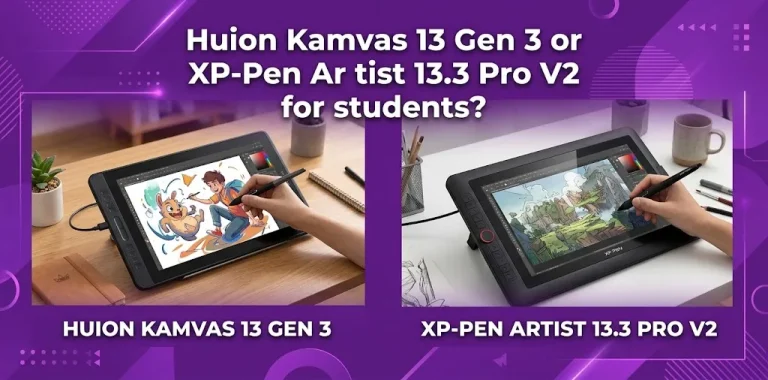

If you need a pen display mainly for online classes, the Huion Kamvas 13 Gen 3 is the better overall choice for most teachers and students because its 13.3-inch screen gives you more room for notes, diagrams, PDFs, and whiteboard tools. The XP-Pen Artist 12 3rd is a stronger pick if you value portability, higher screen brightness, a lighter body, and a built-in dial for shortcuts.
Both are drawing displays rather than standalone computers. You connect them to a compatible computer and use them to write or draw inside apps while teaching or studying online.
What matters most for online classes?
An online-class pen display does not need the same features as a professional illustration workstation. For teaching, the most useful features are:
- A comfortable screen size for handwriting and diagrams
- Low pen latency and accurate tracking
- A laminated display to reduce the gap between the pen and cursor
- A stable stand or comfortable viewing angle
- Easy computer connectivity
- Useful shortcut controls
- Good screen brightness for long sessions
- Compatibility with your computer and teaching software
Both models cover the basics well. The main differences are their screen size, physical design, controls, brightness, and pen experience.
XP-Pen Artist 12 3rd vs Huion Kamvas 13 Gen 3
| Feature | XP-Pen Artist 12 3rd | Huion Kamvas 13 Gen 3 |
|---|---|---|
| Display | 11.9-inch | 13.3-inch |
| Resolution | 1920 × 1080 | 1920 × 1080 |
| Refresh rate | 60Hz | 60Hz |
| Active area | 264 × 149 mm | 293.8 × 165.2 mm |
| Pressure sensitivity | 16,384 levels | 16,384 levels |
| Tilt support | ±60° | ±60° |
| Screen | Fully laminated, anti-glare glass | Fully laminated, anti-glare etched glass |
| Brightness | 260 nits typical | Around 200–220 nits, depending on specification |
| Shortcut controls | X-Dial plus shortcut controls | 5 keys, 2 dials, and 2 function buttons |
| Weight | 719 g | 865 g |
| Stand | Included foldable stand | Optional stand |
| One-cable option | Yes, with compatible USB-C setup | USB-C options available |
| Best fit | Portable teaching and note-taking | Larger workspace and frequent teaching |
The core drawing specifications are quite similar. Both offer 16,384 pressure levels, ±60-degree tilt recognition, 1080p resolution, and laminated screens.
Which is better for online teaching?
Huion Kamvas 13 Gen 3: better for most teachers
The biggest advantage is the 13.3-inch display.
That extra screen area matters when you are sharing your screen during a lesson. You can have a larger writing area while still seeing toolbars, menus, lesson materials, or reference content.
The Kamvas 13 Gen 3 provides a larger active area than the Artist 12 3rd. Both have Full HD resolution, so the Huion gives you more physical writing space at the same resolution.
This makes the Huion especially useful for:
- Math equations
- Science diagrams
- Handwritten explanations
- Annotating PDFs
- Online whiteboards
- Digital worksheets
- Art demonstrations
- Screen sharing during lessons
The Huion also has five programmable press keys, two dials, and two function-switch buttons. That gives you several physical controls for tasks such as undo, zoom, brush size, scrolling, or other shortcuts.
XP-Pen Artist 12 3rd: better for portability
The Artist 12 3rd has a smaller 11.9-inch screen, but that can actually be an advantage if you frequently move between locations.
It weighs about 719 grams, while the Kamvas 13 Gen 3 weighs about 865 grams. The XP-Pen is also slightly smaller physically.
The Artist 12 3rd includes a foldable stand and supports a one-cable USB-C connection when the connected computer supports the required connection.
For a teacher who travels between a home office, classroom, and other locations, those details can make a noticeable difference.
Pen performance: is there a meaningful difference?
On paper, both tablets are highly capable.
The Artist 12 3rd uses XP-Pen’s X4 Smart Chip Stylus, with 16,384 pressure levels, a 2g initial activation force, and ±60-degree tilt support. Its pen technology is designed to provide responsive and accurate strokes.
The Kamvas 13 Gen 3 uses Huion’s PenTech 4.0 PW600L stylus with 16,384 pressure levels, ±60-degree tilt recognition, and a high report rate.
For normal online teaching, you are unlikely to choose between these tablets because one has more pressure levels. Both already provide far more pressure sensitivity than you need for ordinary handwriting, annotation, and diagram work.
What matters more is whether the pen feels comfortable in your hand and whether the driver is correctly configured.
Screen size matters more than you might expect
For online classes, the screen-size difference is one of the most important reasons to choose the Huion.
The Artist 12 3rd has an 11.9-inch 1920 × 1080 display. The Kamvas 13 Gen 3 has a 13.3-inch 1920 × 1080 display.
The resolution is the same, but the Huion gives you a larger physical canvas.
Imagine teaching algebra and writing:
2x + 5 = 17
On either tablet, the writing will work. But if you regularly keep a digital whiteboard open while also using menus, toolbars, or reference material, the larger Huion workspace gives your hand more room.
For simple signatures, short notes, and occasional annotations, the XP-Pen’s smaller screen is less of a concern.
Display quality: XP-Pen has an advantage in brightness
The Artist 12 3rd lists a typical brightness of 260 nits and a wide color gamut. It also uses anti-glare glass designed to reduce reflections.
The Kamvas 13 Gen 3 uses an FHD IPS display with anti-glare etched glass and a wide color gamut.
For teaching, color gamut is not the deciding factor unless you teach art or design.
Brightness can matter more if your teaching space has strong daylight.
If your teaching space is bright, the XP-Pen has a useful advantage on paper. If your main priority is having more room to write, the Huion’s larger display may matter more.
Shortcut controls: which one is easier for teaching?
Both give you physical controls, but they approach them differently.
The Artist 12 3rd features an X-Dial and customizable shortcut controls. The dial can be useful for actions that benefit from gradual adjustment, such as zooming or changing brush size.
The Kamvas 13 Gen 3 provides five programmable press keys, two dials, and two function-switch buttons.
For a teacher, physical controls can be useful for:
- Undoing a mistake
- Zooming in on a diagram
- Zooming out
- Changing brush size
- Scrolling through a document
- Switching tools
If you like having several dedicated controls available, the Huion has a strong advantage.
If you prefer a compact design with a prominent dial, the XP-Pen is appealing.
Which one is easier to set up for Zoom or online classes?
Neither tablet replaces your computer or webcam.
The normal setup is:
Computer → pen display → teaching application
You still run your online class from your Windows or Mac computer. The pen display acts as an interactive screen where you can write, draw, annotate, or control compatible software.
Before buying, check your computer’s ports carefully.
A USB-C port does not automatically mean that every USB-C connection can carry display output. Your computer must support the required video and power functions.
For a teaching setup, also test:
- Display duplication or extension
- Pen calibration
- Your preferred whiteboard application
- PDF annotation
- Screen sharing
- Microphone and webcam placement
- Cable length and desk space
The tablet itself is only one part of the teaching setup.
What if you teach math, science, or other subjects?
The Huion Kamvas 13 Gen 3 gets the edge.
Math and science teachers often need more space for equations, graphs, labels, diagrams, and handwritten explanations. The larger 13.3-inch working area makes those tasks more comfortable.
For example, a teacher explaining geometry may need to draw a triangle, label three angles, write equations beside it, and still keep enough room for corrections.
The larger Huion workspace is better suited to this type of lesson.
What if you teach art?
This is closer.
Both tablets offer pressure sensitivity, tilt support, laminated displays, anti-glare surfaces, and Full HD resolution. The XP-Pen has a particularly strong display specification, while the Huion gives you a larger working area.
For an art teacher who demonstrates detailed drawing techniques, I would lean toward the Huion Kamvas 13 Gen 3 because the larger canvas provides more room for demonstrations.
For an art student who travels frequently and wants a lighter device, the Artist 12 3rd makes more sense.
Which one is better for long teaching sessions?
The answer depends on how you position the tablet.
A larger screen can make writing more comfortable because you have more physical space for your hand. The Huion can be paired with a suitable stand for a comfortable viewing angle, while the XP-Pen Artist 12 3rd includes a foldable stand.
The included stand is an advantage for the XP-Pen because you do not have to purchase one separately.
For either tablet, avoid placing the display completely flat on the desk for hours. A slightly raised angle can make writing and viewing more comfortable.
Portability: XP-Pen wins
If you teach in different locations, the Artist 12 3rd is easier to carry.
It weighs 719 grams and has a compact 11.9-inch design. It also includes a foldable stand and basic accessories.
The Kamvas 13 Gen 3 weighs 865 grams, so it is still portable, but it is larger and heavier.
If your tablet normally stays on one desk, this difference is minor.
If you carry it in a backpack several times a week, the XP-Pen’s lighter body becomes much more useful.
Which one should you buy?
For most online teachers and students, I would choose the Huion Kamvas 13 Gen 3.
The larger 13.3-inch screen is the main reason. You get more room for handwriting, diagrams, annotations, and digital whiteboards without giving up Full HD resolution or modern pen technology.
Choose the XP-Pen Artist 12 3rd instead if:
- You travel frequently with your tablet
- You want the lighter option
- You prefer a smaller desk footprint
- You want a stand included
- You value the higher listed screen brightness
- You like XP-Pen’s X-Dial control system
- You find the XP-Pen significantly cheaper at the time you buy
Choose the Huion Kamvas 13 Gen 3 if:
- You teach several hours a week
- You write a lot during lessons
- You teach math or science
- You annotate PDFs frequently
- You use large digital whiteboards
- You want a larger working area
- You prefer having more physical shortcut controls
Two practical online-class setups
Example 1: Math teacher working from home
A math teacher spends most of the day at one desk and writes equations on a digital whiteboard.
The Kamvas 13 Gen 3 would be the better fit. The larger active area gives the teacher more room to write while the shortcut keys and dials can reduce the need to reach for the keyboard.
Example 2: College student moving between home and campus
A student uses a pen display for occasional handwritten notes, PDF annotation, and online tutoring but carries the device between locations.
The Artist 12 3rd could be the smarter choice. Its smaller body and lower weight make it easier to transport, while the 11.9-inch FHD display is still large enough for normal annotation and drawing work.
A few things to check before ordering
Do not choose solely from the specification sheet.
Before buying either model, check:
- Whether your computer supports the required display connection
- Whether you have enough USB ports
- Whether your desk has enough space
- Whether you need an additional stand
- Whether your preferred teaching app works properly with pen input
- Whether you need Windows, macOS, ChromeOS, Android, or Linux compatibility
- Whether the seller provides a suitable US warranty and return policy
Also check the latest driver and operating-system requirements before purchase because compatibility can change with software updates.
Frequently Asked Questions
Is the XP-Pen Artist 12 3rd good enough for online teaching?
Yes. Its 11.9-inch Full HD laminated display, 16,384-level pressure sensitivity, shortcut controls, and included stand make it well suited to digital whiteboards, handwriting, diagrams, and PDF annotation.
Is the Huion Kamvas 13 Gen 3 better than the Artist 12 3rd?
For online classes, the Huion is generally the better choice because its 13.3-inch screen provides a larger writing area while keeping the same 1920 × 1080 resolution. The XP-Pen is more attractive if portability, lower weight, and its compact design are higher priorities.
Can I use either tablet for Zoom or other online teaching platforms?
Yes, as long as your computer and teaching software support the required setup. The pen display connects to the computer and lets you write or draw in compatible whiteboard, annotation, presentation, or creative applications; the tablet itself does not run the online meeting independently.
Final Recommendation
For online classes specifically, pick the Huion Kamvas 13 Gen 3 if the two are close in price. Its larger 13.3-inch workspace is more useful for handwriting, diagrams, annotations, and long teaching sessions.
Pick the XP-Pen Artist 12 3rd if you care more about portability, a lighter body, included stand, higher listed brightness, and its X-Dial shortcut system.
The most practical tip is to check your computer’s USB-C and display-output capabilities before ordering. A great pen display is only useful if your computer can connect to it properly.