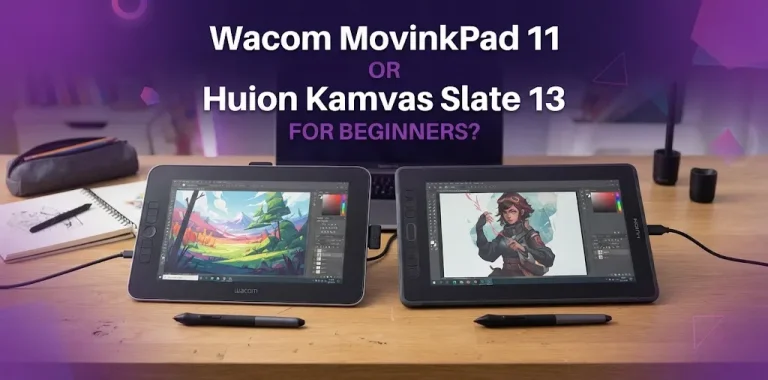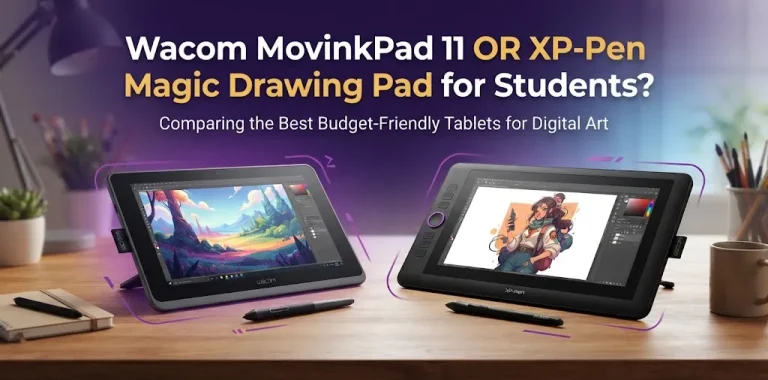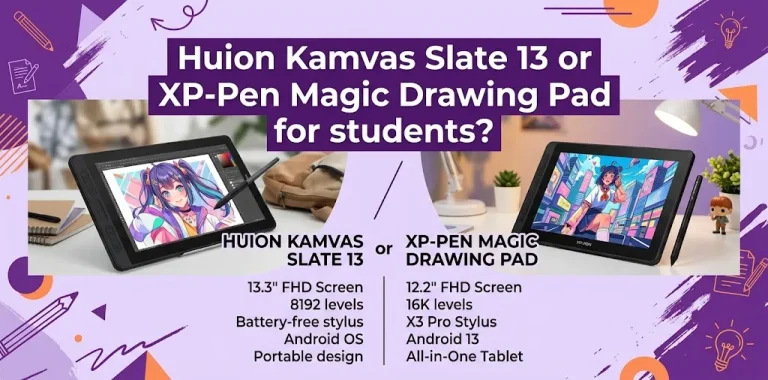
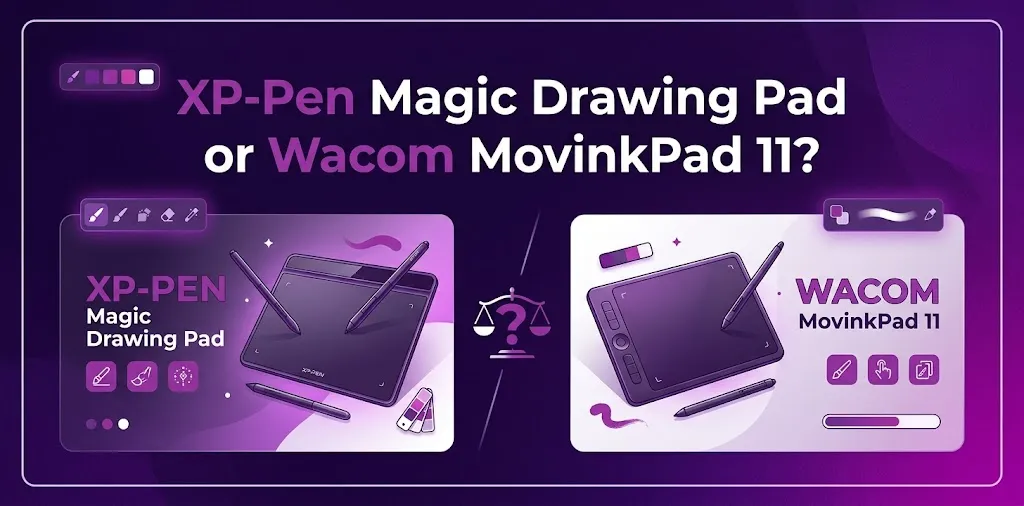
The XP-Pen Magic Drawing Pad and Wacom MovinkPad 11 are two standalone Android drawing tablets built for artists who want to draw without connecting to a computer. They look similar on paper, but their strengths are different: the XP-Pen offers a larger screen, more storage, and stronger value, while the Wacom focuses more heavily on the drawing experience and pen feel.
If you want the better drawing-focused experience, the Wacom MovinkPad 11 is the stronger choice. Its Wacom Pro Pen 3, anti-glare etched display, and artist-focused software experience make it especially appealing to people who care most about how the tablet feels when drawing.
If you want more screen space, more storage, expandable storage, and better overall value, the XP-Pen Magic Drawing Pad is the better buy. Its 12.2-inch display and 256GB of storage make it more flexible as an all-purpose standalone creative tablet.
How the Two Tablets Compare
| Feature | XP-Pen Magic Drawing Pad | Wacom MovinkPad 11 |
|---|---|---|
| Display size | 12.2 inches | 11.45 inches |
| Resolution | 2160 × 1440 | 2200 × 1440 |
| Screen ratio | 3:2 | 3:2 |
| Display surface | X-Paper, anti-glare | Anti-glare etched glass |
| Stylus | X3 Pro Slim Stylus | Wacom Pro Pen 3 |
| Pressure sensitivity | 16,384 levels | Wacom Pro Pen 3 support |
| Tilt support | Up to 60° | Supported |
| RAM | 8GB | 8GB |
| Internal storage | 256GB | 128GB |
| Expandable storage | microSD up to 1TB | No microSD expansion listed |
| Operating system | Android 14 | Android 14 |
| Battery | 8,000mAh | 7,700mAh |
| Weight | About 590g | Lightweight standalone design |
| Official US price | Around $499.99, with promotions sometimes lowering it | $499.95 |
Current prices and promotions can change, so the final price gap may be more important than the list price. Both devices have also been sold around the same general price point in the United States.
The Biggest Difference: Drawing Feel
Specifications do not tell the whole story with drawing tablets.
A tablet can have more pressure levels, more storage, or a larger screen and still feel less natural to use for drawing. This is where the Wacom MovinkPad 11 has its strongest argument.
Wacom has spent decades building digital drawing tools, and the Pro Pen 3 is one of the main reasons artists consider the MovinkPad 11. The tablet is designed around the act of picking up the pen and starting to draw.
The XP-Pen Magic Drawing Pad takes a different approach. It tries to combine a serious drawing device with the usefulness of a larger Android tablet. Its X3 Pro Slim Stylus offers 16,384 pressure levels and tilt support, while the larger X-Paper display gives you more physical space for your artwork.
Why pen feel matters more than pressure-level numbers
It is easy to see 16K pressure levels and assume that the XP-Pen automatically has the better stylus.
That is not how most artists experience a pen.
What matters more in daily use is:
- How quickly the pen responds
- How predictable pressure changes feel
- How accurate the cursor feels across the display
- How comfortable the pen is during long sessions
- How natural the screen texture feels
- How well palm rejection works
For example, a beginner making simple illustrations may never notice the difference between 8K and 16K pressure sensitivity. But that same person may notice that one pen feels more comfortable or that one screen produces a more natural paper-like resistance.
That is why the Wacom MovinkPad 11 is the better choice for buyers who care mainly about the drawing experience itself.
XP-Pen Magic Drawing Pad Has the Better Screen Size
The Magic Drawing Pad uses a 12.2-inch display, compared with the MovinkPad 11’s 11.45-inch screen.
That difference may sound small, but it matters because both devices use a 3:2 aspect ratio. The extra screen space gives the XP-Pen a more comfortable working area for:
- Larger illustrations
- Split-screen reference images
- Digital painting
- Photo editing
- Watching tutorials while working
- General tablet use
The XP-Pen is still thin and portable, but it gives you a little more room to move your hand across the screen.
An illustrator working on detailed artwork
Imagine you are painting a character and need your reference photo open beside your drawing app.
On the XP-Pen, the larger display can make that workspace feel less cramped. You may not need to zoom or rearrange panels as often.
The Wacom can still handle the same task, but its smaller display favors portability over extra workspace.
For artists who frequently work on full illustrations, the XP-Pen’s larger screen is a meaningful advantage.
The Wacom MovinkPad 11 Is More Focused on Artists
The Wacom MovinkPad 11 is not trying to be a powerful general-purpose Android tablet first and a drawing device second.
Its main purpose is to make digital drawing easy to start.
The device runs Android 14 and supports apps from the Android ecosystem, but Wacom’s identity is still centered on creative work. It also includes Quick Drawing functionality designed to help you start sketching quickly.
This makes the MovinkPad 11 especially appealing if your goal is simple:
Pick up the tablet, open a canvas, and draw.
That focused approach may be more valuable than extra storage or a larger display for artists who already have another computer or tablet for general use.
XP-Pen Magic Drawing Pad Gives You More Storage
Storage is one of the clearest wins for the XP-Pen Magic Drawing Pad.
It comes with 256GB of internal storage, while the Wacom MovinkPad 11 has 128GB. The XP-Pen also supports microSD expansion up to 1TB.
That matters more than some buyers expect.
Digital artists can quickly collect:
- Large illustration files
- Brush packs
- Reference images
- Downloaded tutorials
- Time-lapse videos
- 3D assets
- Multiple versions of artwork
If you regularly keep large files directly on your tablet, the XP-Pen offers more flexibility.
A student using one device for everything
Suppose you are a college art student who wants one device for class notes, digital artwork, downloaded references, and entertainment.
The 256GB internal storage and microSD support on the XP-Pen may make it easier to use as your main portable device.
The Wacom can still work well for this purpose, but its 128GB storage and lack of listed microSD expansion make storage management more important.
For a buyer who wants one tablet to handle several creative and everyday jobs, the Magic Drawing Pad makes more sense.
Which Display Is Better?
This depends on what you mean by “better.”
The XP-Pen Magic Drawing Pad has:
- A larger 12.2-inch display
- 2160 × 1440 resolution
- Anti-glare and anti-fingerprint surface treatment
- A paper-like X-Paper drawing surface
- 97% sRGB coverage
The Wacom MovinkPad 11 has:
- An 11.45-inch display
- 2200 × 1440 resolution
- Anti-glare etched glass
- 99% sRGB coverage
- A 60Hz/90Hz refresh-rate specification
On paper, the Wacom offers slightly stronger color coverage and a higher listed resolution, while the XP-Pen gives you a physically larger canvas.
For most artists, neither screen should be dismissed as the weak point. The more important question is whether you want a larger canvas or Wacom’s more drawing-centered screen-and-pen experience.
Performance Is Close Enough for Most Artists
Both tablets are based on Android 14 and include 8GB of RAM.
The Wacom uses a MediaTek Helio G99 processor, while XP-Pen lists an octa-core MediaTek MT8781 processor for the Magic Drawing Pad. These are not flagship tablet chips, so neither device should be expected to perform like a high-end iPad Pro or powerful desktop workstation.
For typical digital art work, they are designed for:
- Sketching
- Illustration
- Comic art
- Basic animation work
- Photo editing
- Reference browsing
- Social media artwork
The performance difference is less important than the drawing experience unless you use unusually demanding files or apps.
Large canvases, heavy brush effects, and complicated projects can place more stress on Android drawing hardware. If your work regularly involves huge multilayer illustrations, a standalone Android drawing tablet may not replace a powerful computer.
Battery Life and Portability
The XP-Pen lists an 8,000mAh battery and the Wacom lists a 7,700mAh battery. Battery capacity alone does not guarantee that one will last longer in real-world use because display brightness, applications, and usage patterns also affect battery life.
Both are built for portable drawing.
The XP-Pen is about 590 grams and measures 6.9mm thick. The Wacom is also designed as a lightweight all-in-one device that can be carried easily for sketching away from a desk.
The practical difference comes down to size:
- MovinkPad 11: Easier to treat like a compact sketchbook
- Magic Drawing Pad: Gives you more workspace without becoming a large desktop device
If you often draw on a couch, in a coffee shop, or while traveling, the Wacom’s smaller size may feel more convenient.
If you want something portable but still want a larger working area, the XP-Pen is more appealing.
What You Get for Your Money
This comparison becomes more interesting when the two tablets are priced similarly.
At their regular official US prices, both have been listed at roughly $500. XP-Pen, however, has frequently used promotions that can lower the Magic Drawing Pad’s price.
If the prices are nearly identical, the decision is mostly about drawing feel versus overall hardware value.
When the Wacom is the better value
Choose the Wacom if you believe you will spend most of your time actually drawing and you place a high value on:
- Wacom’s pen technology
- A focused drawing experience
- Strong pressure and tilt performance
- A compact sketchbook-like design
- A more established drawing-tablet ecosystem
When the XP-Pen is the better value
Choose the XP-Pen if you want more hardware for your money, especially:
- A larger screen
- 256GB of storage
- microSD expansion
- A larger battery
- A more all-purpose tablet experience
- Potentially lower sale pricing
If the XP-Pen is significantly cheaper than the Wacom when you shop, that can change the recommendation quickly.
Which One Is Better for Beginners?
Both can work well for beginners because neither requires a computer.
The Wacom MovinkPad 11 is probably easier to recommend to a beginner who wants to learn digital art and does not want to spend time comparing technical settings. Its main appeal is that it feels like a dedicated digital sketchbook.
The XP-Pen Magic Drawing Pad is better for beginners who want a tablet that can grow into several roles.
For example, someone who wants to:
- Learn digital drawing
- Take notes
- Watch videos
- Store large files
- Use Android apps
- Carry one device while traveling
may get more long-term flexibility from the XP-Pen.
So the better beginner choice depends on the beginner.
A beginner who wants to become a better digital artist may prefer the Wacom.
A beginner who wants one versatile creative tablet may prefer the XP-Pen.
Which One Is Better for Professional Artists?
Neither should automatically replace a professional desktop workstation for every type of production work.
However, they can both be useful for professional artists as:
- Portable sketch devices
- Travel companions
- Secondary drawing tablets
- Digital sketchbooks
- Reference and concept art devices
The Wacom MovinkPad 11 is more appealing to professionals who are already comfortable with Wacom’s drawing ecosystem and care most about pen behavior.
The XP-Pen is more appealing to professionals who need more local storage and want a larger standalone canvas.
A professional illustrator who spends hours making detailed sketches away from a computer may prefer the Wacom.
A freelance artist who wants to store projects, references, and large media files on one device may prefer the XP-Pen.
Software Could Affect Your Decision
Do not choose either tablet based only on hardware.
Both run Android, which means your preferred drawing app should play a major role in your decision.
Before buying, think about the software you actually plan to use. Check:
- Whether your preferred app is available on Android
- Whether it supports the brush features you need
- How well it handles large canvases
- Whether your existing files can be moved between your other devices
- Whether your workflow depends on desktop-only software
The hardware can be excellent, but a tablet is still the wrong purchase if your main creative software is unavailable or too limited on Android.
This is especially important for artists who expect a standalone tablet to replace a Windows or Mac computer.
Choose the XP-Pen Magic Drawing Pad If You Want More Hardware
The XP-Pen Magic Drawing Pad is the better choice if these points sound more important to you:
- You want the larger 12.2-inch display.
- You need 256GB of internal storage.
- You want microSD expansion.
- You use the tablet for more than drawing.
- You want more room for reference images and artwork.
- You find it at a noticeably lower price than the Wacom.
- You want a standalone creative tablet with stronger overall hardware value.
The Magic Drawing Pad is especially compelling for artists who want one portable device for art, entertainment, and everyday Android use.
Choose the Wacom MovinkPad 11 If You Care Most About Drawing
The Wacom MovinkPad 11 is the better choice if these priorities matter most:
- You care deeply about pen feel.
- You want Wacom’s Pro Pen 3 experience.
- You prefer a compact digital sketchbook.
- You mainly want the device for drawing.
- You want an anti-glare etched display.
- You value a focused artist-first experience over extra storage.
- You prefer a smaller tablet that is easier to carry.
The MovinkPad 11 makes the most sense for someone who is not looking for the biggest specifications list. Its main selling point is that the core drawing experience is the product.
My Recommendation for Most Buyers
For most people choosing strictly between the XP-Pen Magic Drawing Pad and Wacom MovinkPad 11, I would start with one question:
Are you buying a drawing tablet, or are you buying a tablet that is also very good for drawing?
If your answer is “I want the best drawing experience I can get in a compact standalone Android device,” choose the Wacom MovinkPad 11.
If your answer is “I want a larger, more versatile creative tablet with more storage and better hardware value,” choose the XP-Pen Magic Drawing Pad.
The Wacom is the safer pick for the artist who puts the pen-to-screen experience first.
The XP-Pen is the stronger choice for the buyer who wants more screen space, more storage, and more flexibility.
FAQ
Is the XP-Pen Magic Drawing Pad better than the Wacom MovinkPad 11?
The XP-Pen is better in areas such as screen size, internal storage, and expandable storage. The Wacom is generally the stronger choice for buyers who prioritize the pen experience and want a more drawing-focused device.
Does the XP-Pen Magic Drawing Pad have a better pen because it has 16K pressure levels?
Not necessarily. Pressure-level numbers are only one part of the drawing experience. Pen accuracy, pressure response, tilt behavior, screen texture, and overall feel can matter more during real-world drawing.
Can either tablet replace an iPad or computer for digital art?
For sketching and many illustration tasks, either can work as a standalone art device. However, demanding professional workflows, desktop-only software, very large projects, and advanced production work may still require a more powerful computer or another tablet ecosystem.
Final Verdict
The Wacom MovinkPad 11 is the better choice for artists who want the drawing experience to come first. The XP-Pen Magic Drawing Pad is the better choice for buyers who want a larger screen, more storage, and a more versatile standalone device.
My practical tip is simple: if both tablets cost about the same, choose the Wacom for drawing feel and the XP-Pen for overall hardware value. Before buying, check the latest sale price and make sure your favorite Android drawing app fits your workflow.